From Wafers to Gold Wire: The 2026 Q4 Semiconductor Price Surge — Is Your BOM Ready?
ASML parts up 10%, onsemi prices rise Oct 10, AMD full lineup +10% in Q4 — the 2026 semiconductor price surge is hitting every link in the chain. Here's what's driving it and how to protect your BOM.
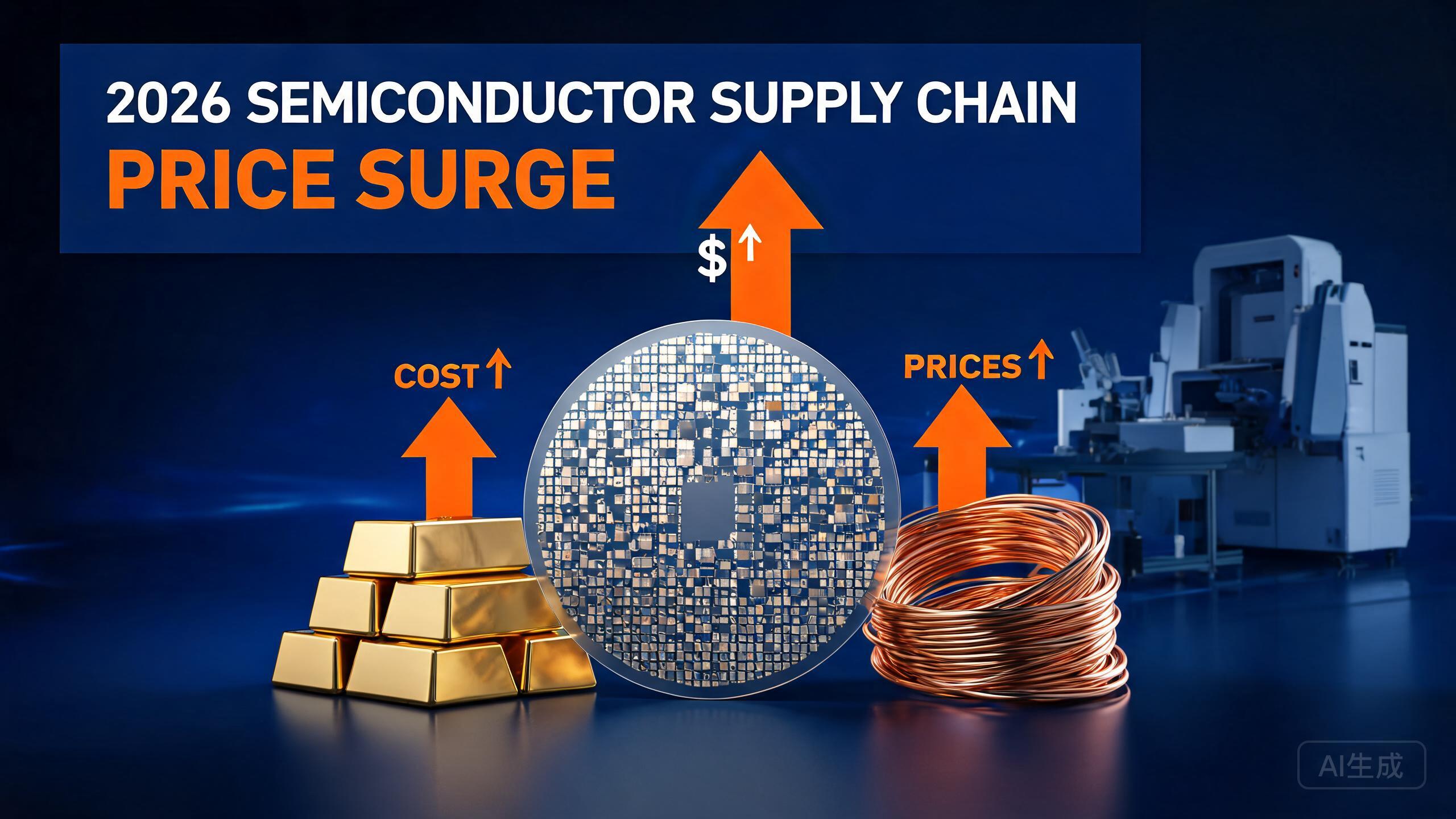
If you’re a procurement manager or hardware engineer reading this in Q4 2026, you’ve probably noticed something in your inbox lately: price increase notices. A lot of them.
From ASML raising spare parts by 10%, to ASE bumping advanced packaging prices up to 20%, to onsemi’s latest round taking effect October 10 — this isn’t just one link in the chain creaking. It’s the whole supply chain, all at once.
Let’s break down what’s happening, why it’s happening, and what you can actually do about it.
The Latest Signals: Who’s Raising Prices — and By How Much
1. ASML: Even Spare Parts Are Going Up 10%. Samsung and SK Hynix Already Said Yes.
In early October, Korean media reported that ASML — the Dutch company that makes practically all the world’s advanced lithography machines — will raise prices on replacement parts and consumables supplied to Korea by 10%, starting January 2027.
This isn’t about new EUV machines (those are already $300M+ a pop). This is about the parts that keep the machines running — everything from routine consumables to core components needed when something breaks. The increase covers both EUV and DUV lines.
The interesting part? ASML floated the proposal to Samsung and SK Hynix first, and negotiated a deal. Translation: the world’s two biggest memory chipmakers already swallowed the increase. And you can bet that cost won’t stay at the fab level.
2. onsemi: Second Price Hike This Year, Effective October 10
Power semiconductor giant onsemi issued a new price notice in September, with new rates taking effect October 10, 2026. This is their second round of adjustments this year alone.
Their reasoning is straightforward: raw materials, manufacturing, and energy costs have all gone up, and internal cost-cutting can only absorb so much.
onsemi isn’t alone. Infineon, Texas Instruments, STMicroelectronics — practically every major power device player has raised prices this year. AI data centers, EVs, and solar energy are all pulling power demand in the same direction, and supply is struggling to keep up.
3. AMD: Full Lineup Up ~10% in Q4. Foundry Costs “Fully Passed Through.”
Supply chain sources say AMD plans to raise prices across its entire chip portfolio by roughly 10% starting in Q4 2026. The reason? TSMC’s wafer foundry costs went up, and AMD is passing the full increase downstream.
Intel is reportedly doing the same.
This is part of a broader shift in the foundry business. Samsung has already raised prices by about 15% for new customers on 4nm, 5nm, and some automotive 8nm nodes. Chinese foundry Nexchip raised all new wafer prices by 10% back in June.
The foundry industry went from “fighting for customers” to “raising prices” in about a year.
Why Is the Whole Chain Going Up? Three Layers of Pressure
Layer 1: AI Demand Is “Drinking Up” Advanced Capacity
This is the big one.
How crazy is AI demand? Look at memory: DDR5 RDIMM 64GB modules are now trading at $3,000–$3,700 each, and 128GB modules exceed $5,000. Samsung, SK Hynix, and Micron are all forecasting another 15–20% increase in Q3.
Memory leads, and logic follows. AI chip orders keep pouring in, keeping advanced-node fabs at full capacity. HBM (high-bandwidth memory) production is squeezing out capacity for other products too.
And here’s the thing people miss: AI doesn’t just eat compute — it eats power. Every new GPU in a data center means more power management ICs, more MOSFETs, more passive components. That’s why power semiconductors are booming right alongside AI chips.
Layer 2: Raw Materials Are Structurally More Expensive
If you think chipmakers are just being greedy, look at their input costs.
- Gold went from ~$2,600/oz in 2024 to a peak of $5,595/oz in early 2026 — that’s over 110% up. Gold wire bonding is still the standard for premium and high-reliability packages (automotive, medical, aerospace). The math isn’t complicated.
- Copper is up roughly 47% year-over-year. Copper foil, lead frames, PCB substrates — all affected. Kingboard raised CCL prices by 10–15% in July and also increased copper foil processing fees.
- Specialty gases and chemicals have seen periodic supply crunches this year, which fed into the second round of price increases at the wafer manufacturing level.
In short: practically everything that goes into making a chip costs more now.
Layer 3: Equipment Costs Keep Snowballing
To meet AI demand, fabs need to expand and move to more advanced nodes. That means buying more equipment.
But equipment itself is getting more expensive. ASML’s 10% parts price hike is just the visible tip. A single EUV scanner now costs well over $300 million. The next-generation High-NA EUV machines are heading toward $400 million each.
Those billions in equipment investment get amortized over every wafer that comes out the door.
What This Means for You: How to Handle BOM Cost Pressure
For procurement teams, hardware engineers, and startups, the question isn’t whether prices are going up — it’s what you’re going to do about it.
1. Re-Evaluate Long-Term Agreements (LTA)
If your volume is reasonably stable, now might be the time to lock in long-term supply agreements. Price security and capacity security matter a lot more than squeezing a few extra cents out of per-unit pricing.
The catch? You need the right partner. A distributor with real stock, traceable parts, and reliable supply beats the cheapest quote you can find — especially when allocations hit.
2. Find Second Sources — Before You Need Them
The worst position to be in during a price surge is: single-sourced on a critical part, and that part just went up 15%.
Get your engineering team to audit the BOM now. What are the second sources for key components? Are there pin-compatible alternatives? Doing this homework early can save you from panic-buying later.
3. Don’t Sleep on the “Boring” Parts
During price surges, everyone watches the hot items — AI chips, power MOSFETs, memory.
But the parts that actually stop production are often the unremarkable ones — passives, connectors, small-signal transistors. They don’t cost much individually, but missing just one can kill a whole build. These “long-tail” parts tend to get overlooked until lead times stretch to 30+ weeks and there’s no stock to be found.
4. Talk to Your Distributor Regularly
This isn’t a sales pitch — it’s just how the industry works.
In a rising market, information is worth real money. Knowing which factory is about to announce a price increase, which part’s lead time just doubled, what alternatives are available — a week of advance notice can pay for itself many times over.
A good distributor doesn’t just sell you parts. They keep you informed.
How Long Will This Last?
Probably the question on everyone’s mind.
Based on the current signals, price pressure is unlikely to meaningfully ease before the second half of 2027.
Here’s why:
- AI demand shows no sign of peaking, and advanced-node capacity stays tight
- Raw material prices (gold, copper, gases) are moving structurally higher, not temporarily
- Equipment investment cycles take years to work through the cost base
That said, not every product category will behave the same way. Memory might see a correction by mid-2027 (it’s risen so fast, some pullback is inevitable). But power semis, analog, and automotive-grade devices are likely to stay tight longer.
The Bottom Line
If you’ve been in this industry long enough, you’ve seen this pattern before: every price surge is also a shakeout.
Some companies lock in supply early, protect their margins, and gain ground on competitors. Others wait too long, get squeezed by costs, and fade away.
The difference isn’t whether you can stop prices from rising — nobody can. It’s whether you see the changes coming and adjust faster than the competition.
What’s on your BOM that’s already feeling the squeeze? Drop a comment below.
Disoic Technology — 79,000+ part numbers in stock, 100% original and traceable, quotes within 24 hours. In a rising market, a reliable stocking distributor isn’t a luxury — it’s your supply chain’s insurance policy.